Preflop Trainer
The fastest way to memorize your preflop ranges. When the action folds to you, should you raise or fold — and with a short stack, shove or fold? Drill it from every seat, deep or short, until it's automatic — or study the full charts. Free, no signup, works on your phone.
Get every chart as a free PDF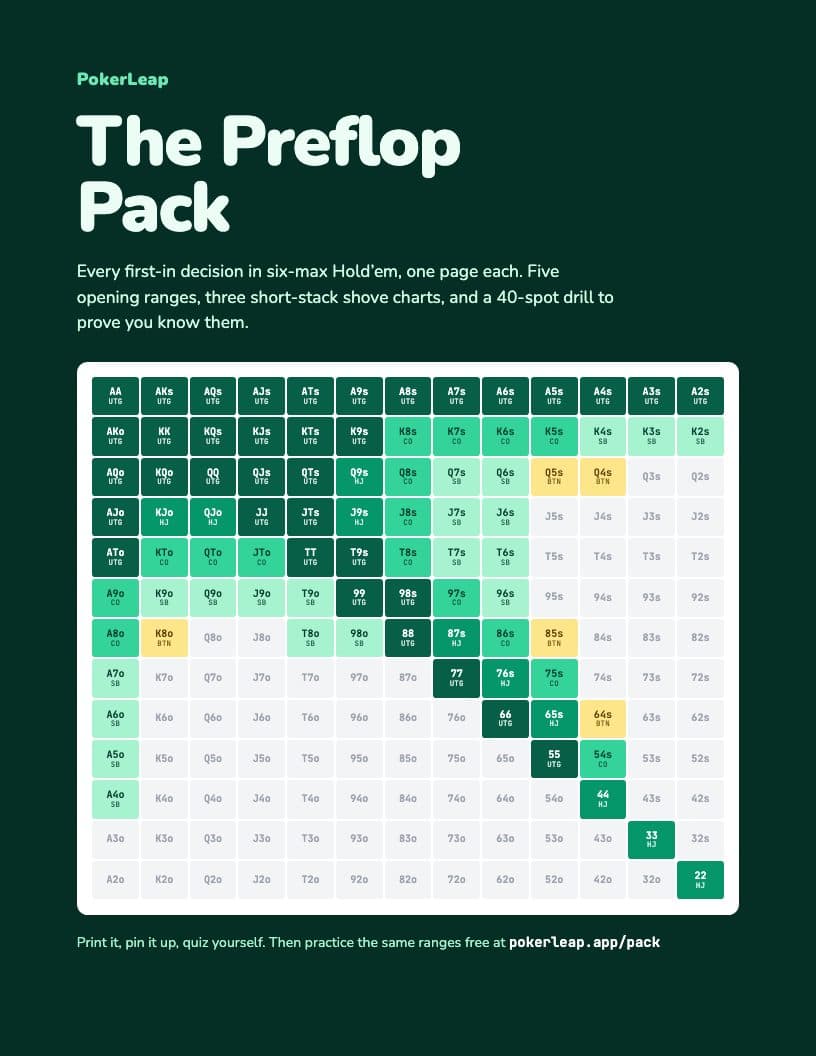
Free PDF
Take the charts with you
The Preflop Pack: 15 printable pages. All five opening ranges, push or fold at 15, 10 and 7 big blinds, and a 40-spot drill with an answer key.
What are preflop opening ranges?
A preflop opening range is the set of starting hands you raise with when everyone folds to you. It's the single most important — and most learnable — decision in poker, because it's finite: there are only 169 starting hand classes, and for each seat the answer is a fixed “raise or fold.” Memorize the charts and you'll never be lost before the flop again. New to which hands to open? Start with our guide to poker starting hands.
Why position changes everything
The later you act, the more hands you can profitably open — because fewer players are left to wake up with a big hand (this is why position matters in poker). That's why the button opens far wider than under the gun:
- Under the Gun:open the top ~15% of hands — First to act with the whole table behind you — play tight.
- Hijack:open the top ~20% of hands — A couple of seats from the button — open a bit wider.
- Cutoff:open the top ~28% of hands — Late position — only the button acts after you, so steal more.
- the Button:open the top ~42% of hands — Best seat in poker — you act last every street, so open wide.
- Small Blind:open the top ~40% of hands — Only the big blind behind you — raise or fold, never limp.
Short stacks: push or fold
With about 15 big blinds or fewer, a first-in raise is effectively your whole stack, so the decision collapses to two options: shove all-in or fold. Like opening ranges, the answer is a chart you can memorize — and it changes with your stack. The shorter the stack, the wider you shove: there is less to lose and the blinds are a bigger share of what you have. The hands that fill the range change too: with no flop left to play, suited connectors lose most of their value while aces and pairs gain, so the best shoves are not the best opens. These ranges sit close to the standard unexploitable push charts for a table with no antes.
| Seat | 100 bb (open) | 15 bb (shove) | 10 bb (shove) | 7 bb (shove) |
|---|---|---|---|---|
| Under the Gun | top 15% | top 14% | top 20% | top 27% |
| Hijack | top 20% | top 17% | top 24% | top 32% |
| Cutoff | top 28% | top 22% | top 31% | top 40% |
| the Button | top 42% | top 31% | top 43% | top 53% |
| Small Blind | top 40% | top 40% | top 55% | top 67% |
Notice that the 15-big-blind shove range is tighterthan the same seat's 100-big-blind opening range. That is not a mistake. Deep, you can open a marginal hand and fold to a re-raise; short, the raise is the stack, so only hands that are happy to get called go in. And once you are short, never make a small raise you would fold to a shove — that is the most expensive leak a short stack has.
How much should you raise?
When you open, raise to a consistent ~2.5–3 big blindsfrom every seat — unlike postflop, preflop open sizing barely changes by position, so there's almost nothing to memorize. Note that the pot-fraction sizing you may have heard of (half pot, two-thirds pot) is a postflopskill, not a preflop one. And when it folds to you, it's raise or fold— never just call (“limp”), which is a common beginner leak.
This trainer covers opening ranges (raise or fold when it folds to you). The next step — what to do when someone raises before you (3-bet, call, or fold) — lives in the full PokerLeap Coach, along with lessons, hand practice, and a daily spot. It's free to start.
Questions people ask
What is a preflop opening range?
The set of starting hands you raise with when everyone folds to you. There are 169 starting-hand classes and, for each seat, each one is either a raise or a fold, so the whole thing is a chart you can memorize. Later seats open more hands because fewer players are left to act behind you.
What is push/fold poker?
With about 15 big blinds or fewer, a first-in raise is effectively your whole stack, so the only sensible options are to move all-in or fold. The right shove range depends on your seat and your stack: the shorter the stack and the later the seat, the wider you shove.
At what stack size should you switch to push or fold?
Around 15 big blinds and below. At 15bb the shove range is tighter than your deep-stack opening range, because deep you can raise a marginal hand and fold to a re-raise, but short the raise is your whole stack. By 10bb and 7bb the ranges widen considerably.
How much should you raise preflop?
When it folds to you, open to about 2.5 to 3 big blinds from every seat; preflop open sizing barely changes by position. Never just call (limp) when it folds to you. With a short stack, do not make a small raise you would have to fold to a shove: go all-in or fold.