Push/Fold Trainer
Down to 15 big blinds or fewer, the question at the table is no longer how much to raise. It is whether your hand is worth your whole stack. You get a hand and a seat, you shove or fold, and the right answer comes with the chart. Free, no signup, works on a phone.
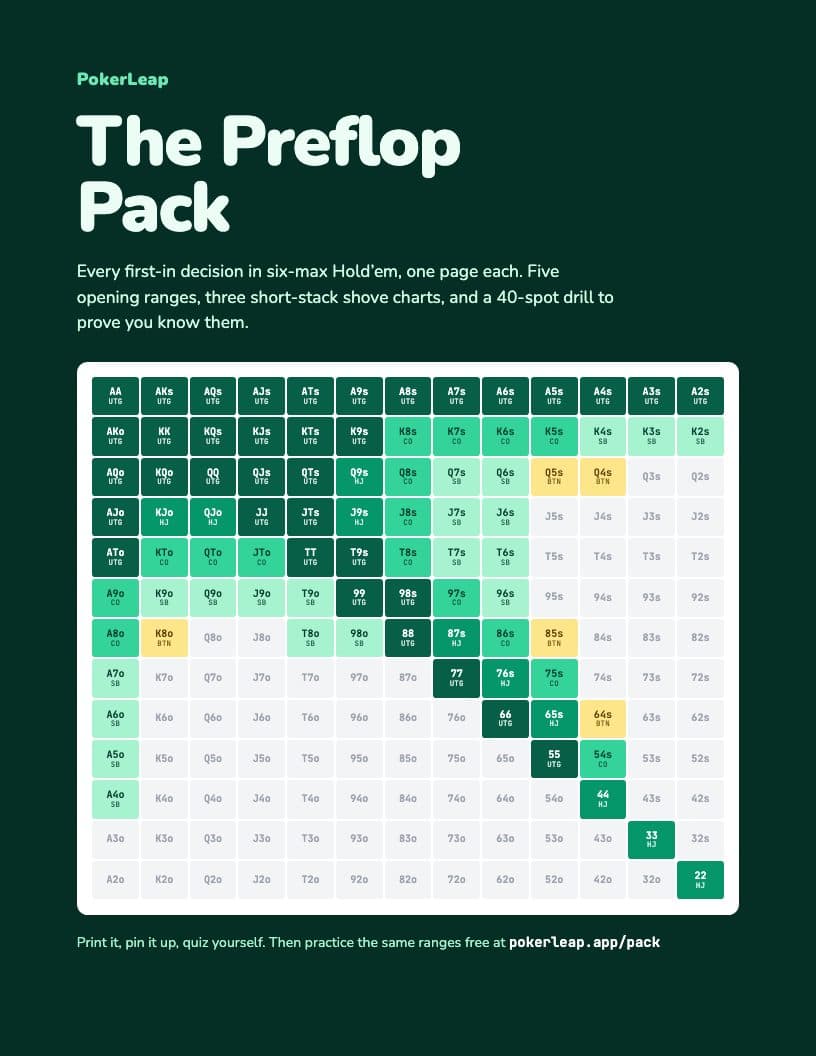
Free PDF
Take the charts with you
The Preflop Pack: 15 printable pages. All five opening ranges, push or fold at 15, 10 and 7 big blinds, and a 40-spot drill with an answer key. Free, no email needed.
Free PDF. No email, no account.
The shove range for every seat
The number is the top share of starting hands to move all-in with when the action folds to you. Every seat gets wider as the stack shrinks, because the blinds are a bigger part of what you have and there is less to lose.
| Seat | 15 bb | 10 bb | 7 bb |
|---|---|---|---|
| Under the Gun | top 14% | top 20% | top 27% |
| Hijack | top 17% | top 24% | top 32% |
| Cutoff | top 22% | top 31% | top 40% |
| the Button | top 31% | top 43% | top 53% |
| Small Blind | top 40% | top 55% | top 67% |
Which hands go in changes too
A shove is not a wider version of an open. With no flop left to play, suited connectors lose most of their value while aces and pairs gain, so the best shoves are not the best opens. That is why you drill it, and why the chart view above is worth a look after a few wrong answers.
These ranges are built for a table with no antes and sit close to the standard unexploitable push charts. If you play with a deeper stack, the preflop trainer covers raise-or-fold opening ranges from every seat at 100 big blinds.
Questions people ask
What is a push/fold chart?
A chart of which hands to move all-in with, and which to fold, when it folds to you and your stack is short. It is one list per seat and stack size, so you can answer in a second instead of working it out at the table.
How wide should you shove on the button with 10 big blinds?
About the top 43% of hands. From the small blind it is about 55%, and from under the gun about 20%. At 15 big blinds the button shoves about 31%, and at 7 big blinds about 53%.
Why is the 15 big blind shove range tighter than a normal open?
Because a first-in raise at that depth is nearly your whole stack, so you cannot fold to a re-raise. Fifteen big blinds is tighter than a 100 big blind open in every seat except the small blind, where the two are the same. King-ten suited opens under the gun at 100 big blinds but folds at 15, and seven-six suited does the same on the button. Pocket deuces go the other way: 10 big blinds is the first stack where they shove from every seat.
Which hands get worse when you are short?
Suited connectors. With no flop left to play they lose most of what made them good: seven-six suited opens from the button deep, but at 15 big blinds only the small blind shoves it, and the button needs 10 to join.
Should you ever limp or min-raise with a short stack?
Not first in. A small raise that you then have to fold to a shove costs you chips for nothing, so with a short stack it is shove or fold.
More trainers & calculators
Hand rankings
What beats what — with a quiz
Preflop trainer
Drill your opening ranges
Which hand wins?
See who wins any showdown
Equity trainer
Practise the call/fold maths
Outs calculator
Count your outs & odds to hit
Pot odds calculator
Work out if a call is worth it
Chip calculator
Chips and blinds for a home game